Device Overview
The WILD device is a Wireless, Interactive, Lightweight Datalogger: an ultra-lightweight multimodal neurologger for freely behaving animals. It combines local neural data logging, auxiliary sensing, onboard processing, BLE configuration and status, synchronization support, and responsive stimulation.
WILD is not a BLE telemetry system. High-bandwidth neural data are recorded locally to microSD; wireless links are used for discovery, configuration, synchronization support, status, low-bandwidth preview, and online control commands.
The device is best understood as a head-mounted acquisition and control unit. Neural acquisition, auxiliary sensing, embedded processing, microSD storage, external I/O, and optional stimulation are handled on the device. The host computer or controller supports setup, timing coordination, status review, selected preview, command delivery, and export.
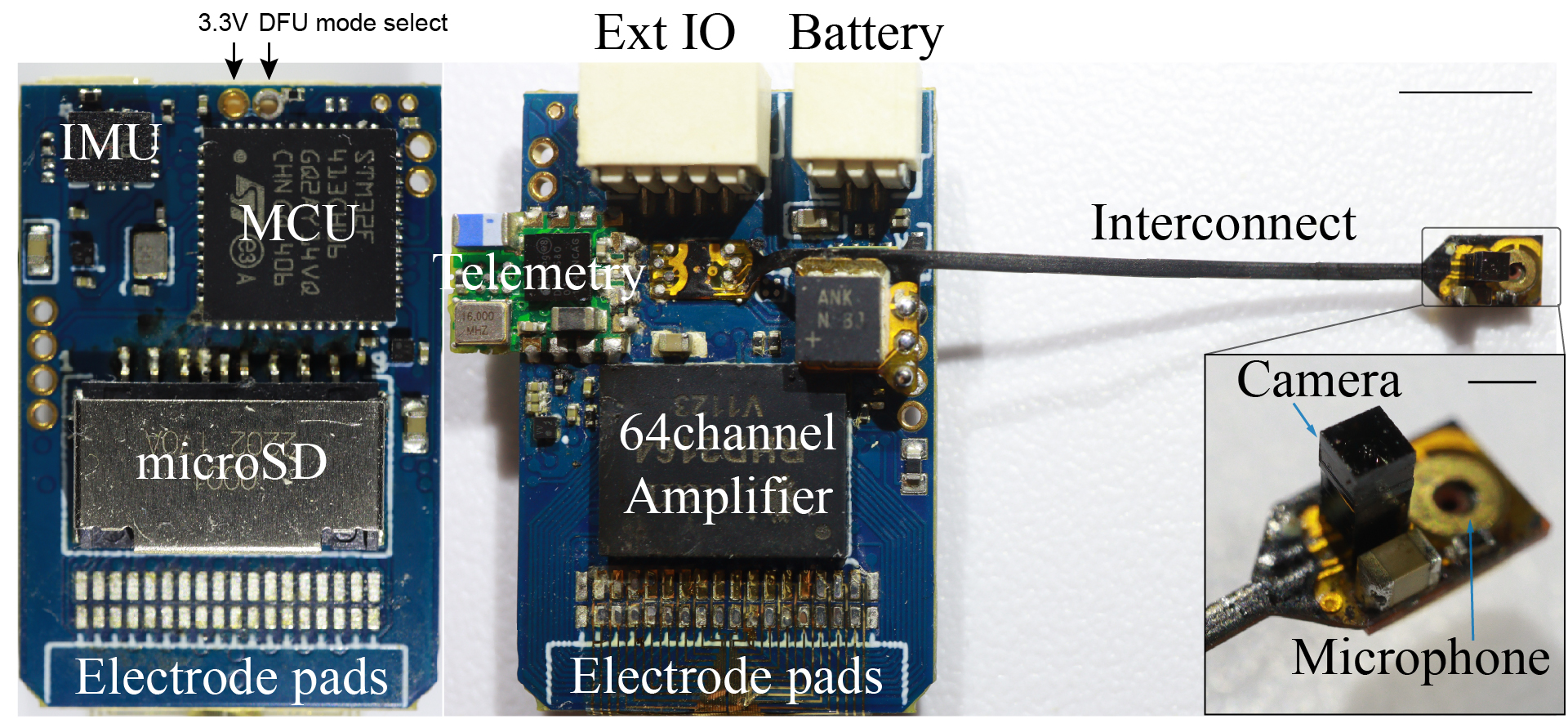
Functional Blocks
Inputs
Device core
Local outputs
Control links
Analysis
Device Interfaces
| Interface | Public documentation focus |
|---|---|
| Neural input | Standard 64-channel connector workflows and WILD flexible-probe workflows. |
| Local storage | Full-resolution neural, IMU, audio, camera, and event data are recorded to microSD. |
| Wireless control | BLE supports discovery, configuration, synchronization support, status checks, selected preview, and commands. |
| External I/O | Sync and control lines connect WILD devices with cameras, behavior systems, stimulation modules, and multi-device sessions. |
| Bench setup | USB and wired interfaces can support setup and validation workflows when high-bandwidth local monitoring is needed. |
Detailed sensor, opto-module, and USB-GPIO board notes are documented in the dedicated Hardware chapters.
Current Public Scope
- The current open-source WILD release is the 64-channel local-storage neurologger workflow.
- Higher-performance Neuropixels-compatible and active-SPI-probe workflows are separate research and variant targets unless explicitly supported by a release note.
- Multi-device experiments use explicit synchronization workflows rather than BLE timestamps alone.
- Mass is configuration-dependent; report device-only mass, probe or module mass, battery mass, and complete implant mass separately.
Core Specifications
| Category | Current WILD specification |
|---|---|
| Neural channels | 64 |
| Device mass | Approximately 1.5 g for the logger board, configuration-dependent |
| Board dimensions | 23.3 x 15.7 mm |
| MCU | Cortex-M4 class MCU for acquisition, embedded DSP, TinyML scheduling, and device control |
| Power input | Use release-specific approved battery options; internal rails are generated by a converter/regulator chain |
| Sampling rates | 1,250-20,000 Hz |
| ADC resolution | 16-bit electrophysiology and microphone data; 10-bit camera data |
| Storage | microSD, Class 10 or better; low-power endurance cards are preferred |
| Recommended cards | Samsung EVO older orange U1 generation or tested Lexar cards |
| BLE | Control link for discovery, synchronization support, status, selected preview, and low-bandwidth commands |
| IMU | BMX160, up to 500 Hz |
| USV microphone | SPH6611LR5H, approximately 1-80 kHz bandwidth |
| Camera | NanEye-C, 320 x 320 px, 16 FPS, 10-bit |
| Stimulation | Optional two-channel laser-diode stimulation module based on TPS6115x |
Supported Modalities
- Local neural electrophysiology recording.
- Responsive closed-loop stimulation from onboard detection.
- IMU sensing and sensor fusion.
- Ultrasonic vocalization audio through ADC data.
- Head-mounted camera data through
misc.dat. - Digital input and synchronization signals.
- External I/O for synchronization, stimulation control, and integration with behavioral equipment.