WILD: wireless neural recording and closed-loop control in freely behaving animals
The Wireless, Interactive, Lightweight Datalogger (WILD) is a head-mounted local-storage platform for neural recording and closed-loop experimental control in freely behaving small animals. The system combines multichannel electrophysiology, auxiliary behavioral sensing, onboard processing, microSD storage, wireless configuration, and validated stimulation workflows.
Why WILD?
Naturalistic neuroscience
Record neural activity while animals explore, interact socially, vocalize, or move through large environments where tethered systems are limiting.
Local full-resolution recording
High-bandwidth neural and multimodal data are written to onboard microSD storage. BLE is used for discovery, configuration, synchronization support, status, preview, and commands.
Closed-loop control
Embedded DSP and curated TinyML workflows support device-local detection and responsive stimulation without requiring continuous full-bandwidth wireless streaming.
Open and reproducible
Hardware files, release images, WILD Console installers, MATLAB scripts, Python tools, and documentation are organized for release-specific methods reporting.
Open-source release
Included in the public workflow: 64-channel local-storage WILD recording, WILD Console on Windows, validated release images, optional stimulation workflows, and post-processing through documented MATLAB and Python scripts.
Not part of the stable public workflow: continuous full-bandwidth BLE telemetry, arbitrary runtime AI-model upload, and separate higher-performance research variants unless a release note explicitly supports them.
Reproducibility record
For each experiment, record the exact release tag, device image filename, hardware revision, WILD Console version, SD-card model, battery, enabled modalities, and analysis-script commit.
Embedded control at the headstage
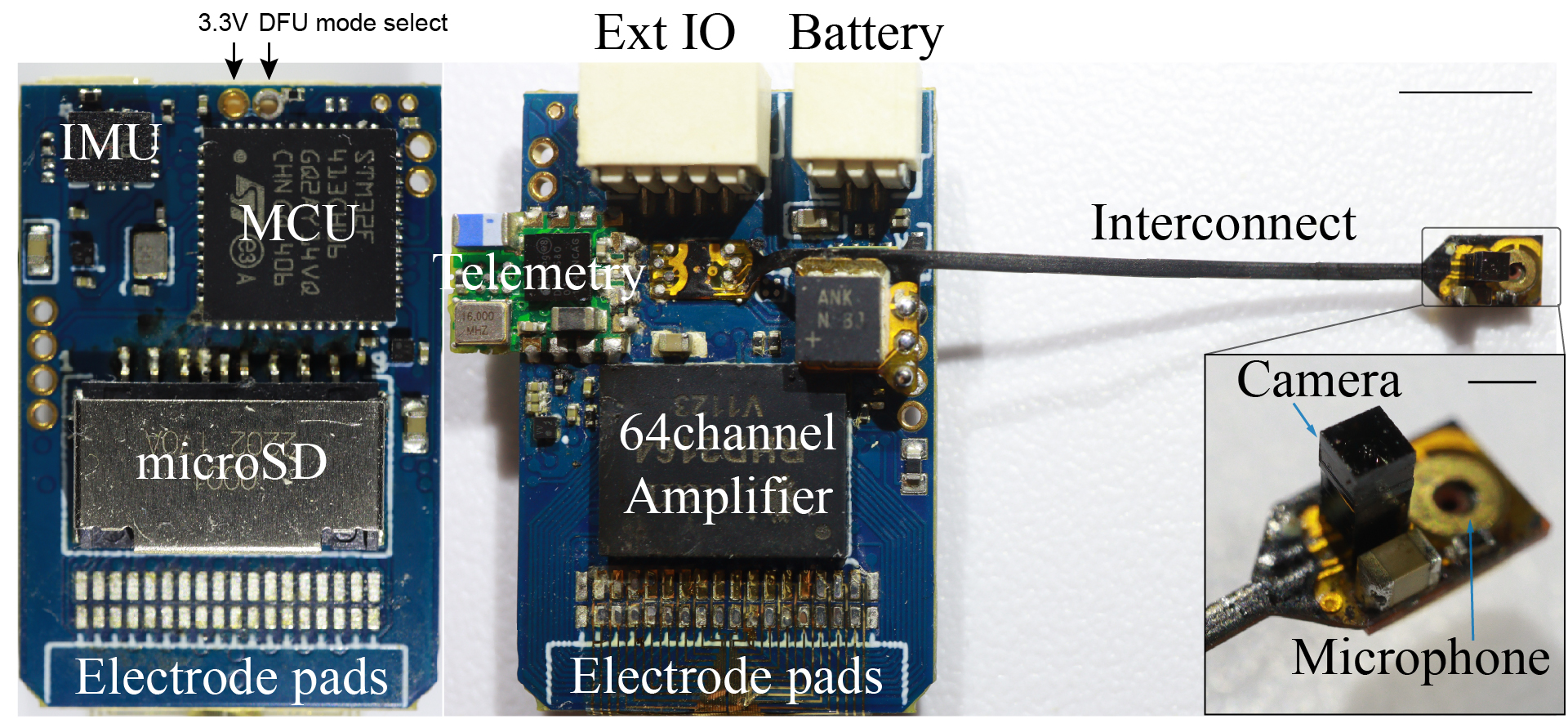
The MCU, IMU, and board-level control electronics sit close to the animal, reducing external cabling while keeping timing-sensitive acquisition local.
Key capabilities
Electrophysiology
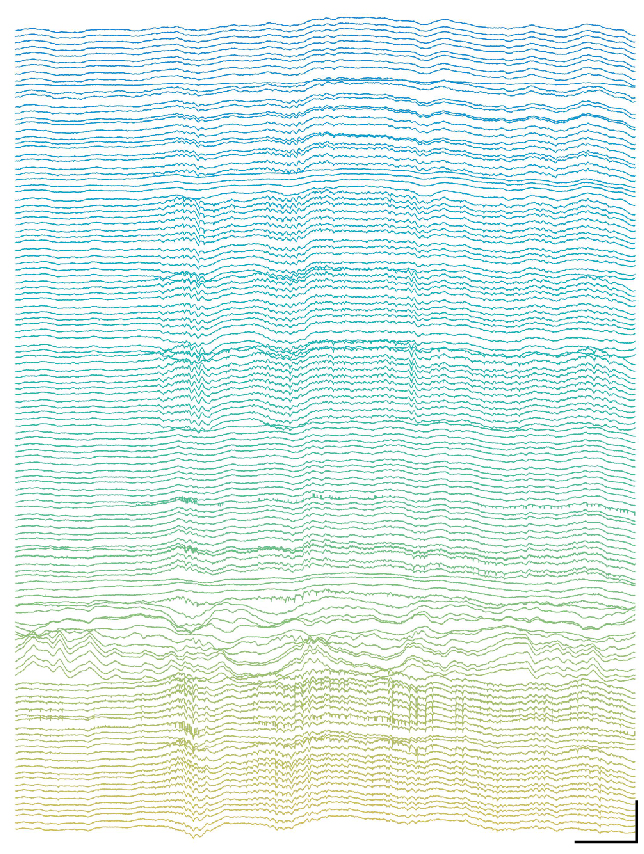
Up to 64 neural channels are recorded locally at release-configured sampling rates for downstream Intan-style analysis and spike sorting.
Behavioral sensing
IMU, digital inputs, ultrasonic audio, and head-mounted camera streams can be captured with the neural recording to support synchronized neuro-behavioral analysis.
Responsive stimulation
Onboard biomarker detection, DSP states, and curated model outputs can trigger stimulation in supported release images and validated hardware configurations.
Multi-device experiments
External I/O, digital events, and post-export alignment workflows support experiments involving multiple WILD devices and behavioral systems.
Field-ready workflow
Local storage, low-power modes, and wireless control make the platform suitable for long recordings and outdoor or large-arena experiments after bench validation.
Specification summary
The public WILD workflow combines local high-bandwidth recording with low-bandwidth wireless control and documented post-processing.
Mode-dependent power values are listed in Hardware / Power, together with release image, SD-card, and battery metadata.
System overview
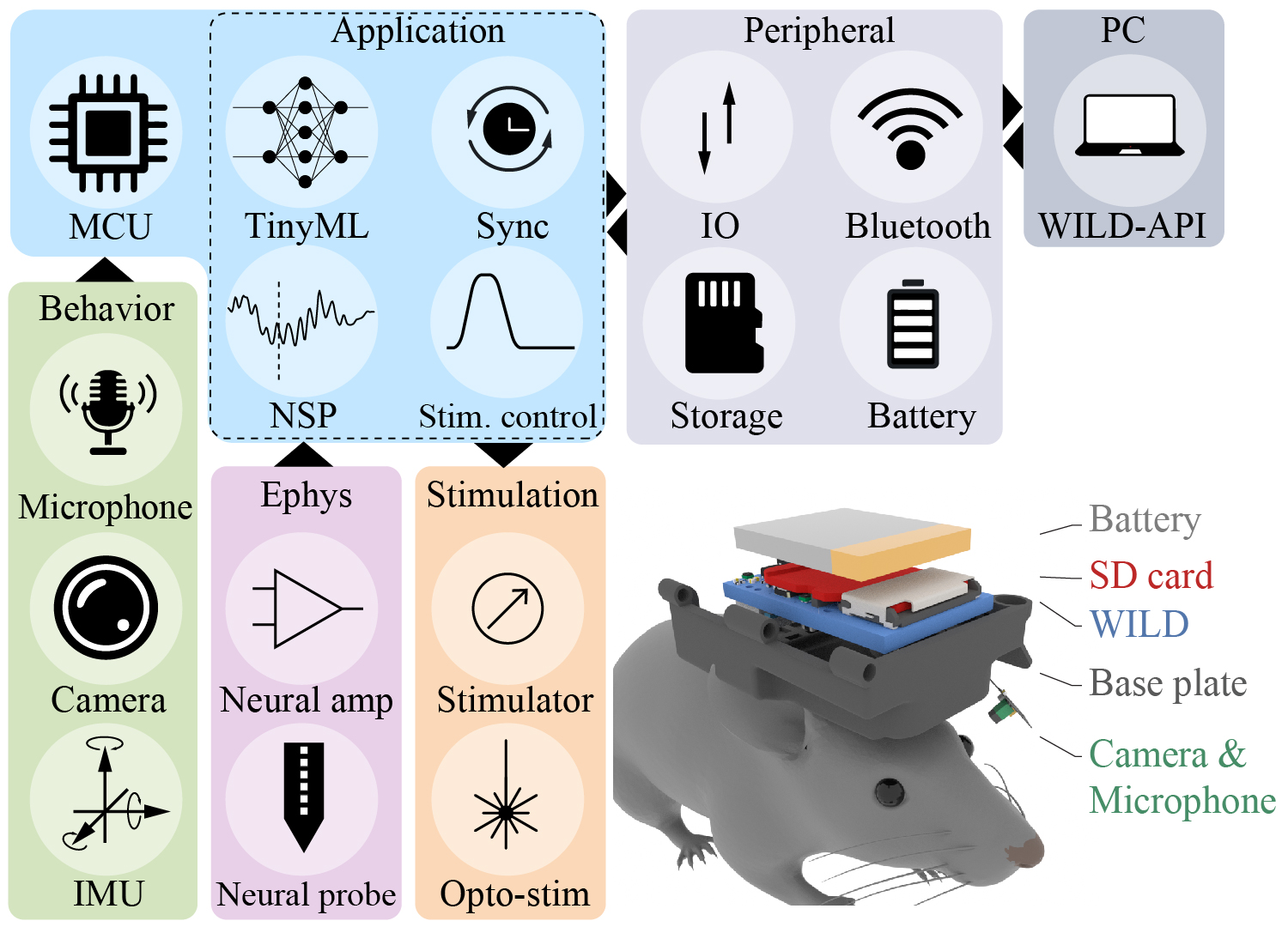
A typical session moves from animal-mounted acquisition to local storage, synchronization, export, and offline analysis.
Research highlights
Outdoor recordings
Local storage and wireless control support electrophysiological recordings in large naturalistic environments where tethering is impractical.
Multi-animal experiments
Wired sync, BLE calibration, and clock-correction workflows coordinate multiple WILD devices and external behavioral systems.
Closed-loop ripple detection
DSP filters support ripple-band detection for responsive hippocampal experiments in validated release images.
Theta phase stimulation
Hilbert and filter modes support phase-aware online control designs when enabled and validated for the release image.
Multimodal behavior
IMU, video, USV, and neural data support studies of social interaction, navigation, and freely expressed behavior.
Open hardware iteration
The repository contains hardware files, validated release assets, WILD Console installers, and analysis scripts.
Quick start
1. Hardware setup
Check connectors, battery polarity, microSD card, probe cabling, sensor cabling, and the release image before the first recording.
2. Data acquisition
Use WILD Console for BLE connection, synchronization support, recording configuration, closed-loop settings, and local logging startup.
3. Data analysis
Convert exported recordings into Intan-style files, IMU outputs, camera or audio media, and spike-sorting inputs.
Recommended first target: complete a short bench recording, export the folder, confirm `amplifier.dat`, `analogin.dat`, `time.dat`, `info.rhd`, and `CE_params.bin`, then open the result with the documented MATLAB or Python workflow.
Publication and citation
Publication status
A manuscript describing the WILD platform is currently under review. Final citation information, including journal, DOI, volume, issue, and page details, will be added only after publication.
Repository and release versions
Before publication, cite the repository or release record and report the hardware revision, release image, WILD Console version, SD-card model, battery configuration, enabled modalities, and analysis scripts used for each dataset.
@misc{wild_repository,
  title        = {WILD: Wireless, Interactive, Lightweight Datalogger},
  author       = {Zhao, Zifang and Chang, Hongyu and Paudel, Praveen and Park, Jaehyo and Liu, Can and Aurelio, Maria Q. and Oliva, Azahara and Fernandez-Ruiz, Antonio},
  howpublished = {\url{https://github.com/ayalab1/Neurologger}},
  note         = {Public documentation and release files. Report the release tag, device image, hardware revision, WILD Console version, and analysis-script commit used in the experiment.},
  year         = {2026}
}
Community
Issues and pull requests
Use GitHub issues for reproducible bugs or documentation gaps, and pull requests for tested fixes, examples, and compatibility updates.